
DOUBLE ANEMONE LOOP
The red figure is the surface being split, moved to a tiled location by the double loop.
3D surfaces formed by the double loop. Each tile is randomized.
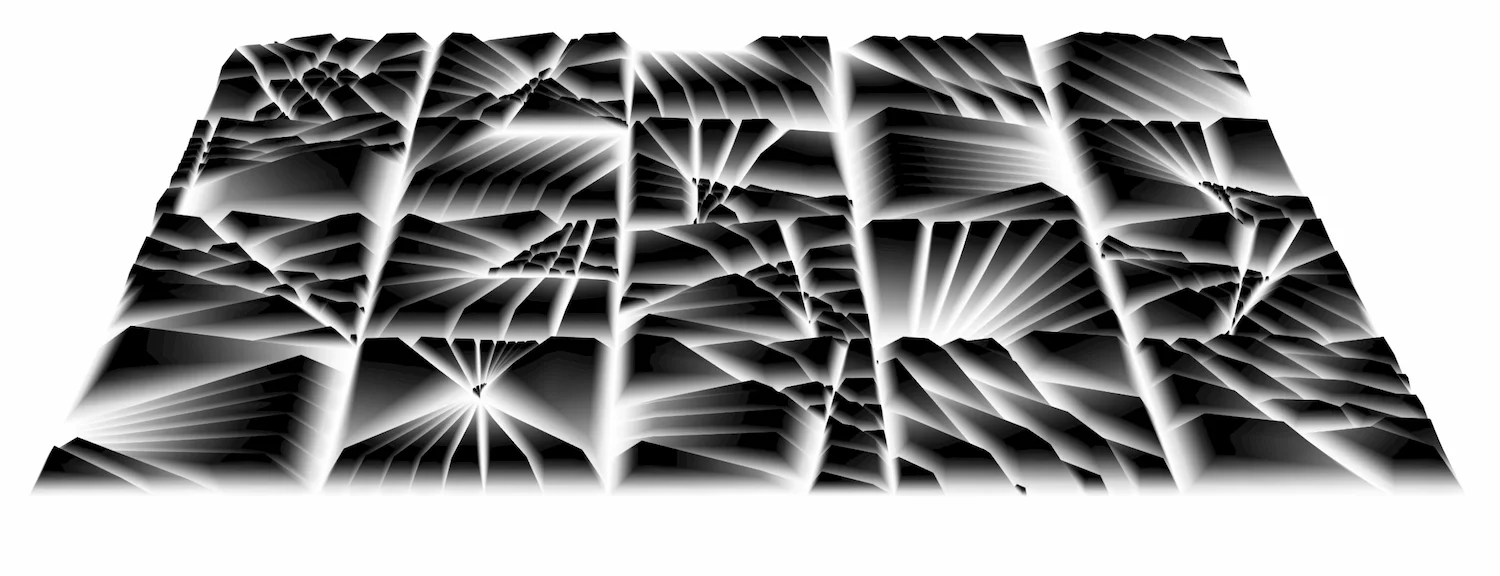
This script demonstrates a nested Double Anemone loop applied to tiled split surface design.
In this example, the inner loop controls movement along the X-axis while the outer loop controls movement along the Y-axis.
The loop counter is used to index the translation of each split surface.
Each tile is randomized by using a math function based on the inner and outer loop counters. This generates a unique random seed, changing the curve split for every iteration.
The inner Loop End component must be set to output the last iteration so it completes its full cycle before the outer loop indexes.
The inner loop trigger is hardwired to Boolean True. The outer loop trigger starts the entire sequence.
These nested loops will generate a complex data tree, which can simply be flattened at the final output.
It is recommended to place a Data Dam or Stream Gate at the output of any Anemone loop. This prevents Grasshopper from trying to compute the downstream script during every iteration.